The story / in the maker's words
A chronograph for thirty.
This watch began with an online listing. Inside the anonymous case was a Lemania 2310, the architecture better known in Omega form as calibre 321—the hand-wound, column-wheel chronograph that became inseparable from the Speedmaster and the moon landings. The movement had already lived one life. I wanted to give it another.
The easy response would have been to place it inside a familiar modern chronograph case. I wanted the opposite: a watch whose proportions began with the movement, whose design belonged somewhere between the 1930s and 1940s and the present, and whose size made it natural to wear every day. More personally, I wanted it finished for my thirtieth birthday.
三十而立At thirty, one stands.
01 / Making the watch
The movement came first.
The 2310 has appeared in an extraordinary range of watches: steel, gold-plated and solid gold; with two registers or three; signed by modest makers and by some of the great maisons. Its compact architecture is part of its appeal. The additional work for an hours recorder can be carried on another layer, allowing the same basic movement to support different dial configurations.
What interested me was not the prestige attached to the calibre, but the discipline its dimensions could impose. Many later watches built around this family expanded the case while leaving the registers where the movement required them to be. The dial became larger, but the sub-dials did not move with it. The empty space grew, and the visual tension weakened.
I have always preferred watches that are small, thin and light. A watch should settle on the wrist and disappear into the day. Once it becomes huge, heavy and unstable, the design problem has been made easier by avoiding it. At that point one might as well strap a pocket watch to the wrist. The difficult—and therefore interesting—target was to make this chronograph smaller.
02 / Making the watch
Thinness is architecture.
I discussed the first dimensions with my watchmaker, Guo Hao—Mr. Guo from this point onwards. We thought the metal body could approach seven millimetres, with the finished watch remaining comfortably below ten. That immediately made the crystal important. On a vintage-style watch, the dome can contribute close to a third of the visible height. The curve, the bezel and the way the crystal meets the case determine whether the watch feels thin even before a calliper confirms it.
The purest solution would have been a closed, seamless back. I nevertheless wanted to see the movement. A conventional display back would have added another ring of metal and another layer of thickness, so we chose an officer caseback: a hinged metal cover that preserves the period character, opening to reveal the mechanism beneath. A clear inner glass protects the movement from dust, moisture and an accidental touch while it is being observed.
That cover also gave the watch a private surface. Around its opening are four divisions, each marking a five-year chapter after thirty. They are reminders of what must be attempted, what must be completed, and how easily time can otherwise be spent without notice.
03 / Making the watch
A case made by subtraction.
The first case drawings imagined an uninterrupted form: a very thin bezel, a relatively small round body and long lugs flowing out from it. The narrow bezel makes the dial appear larger than its actual diameter. The crown followed the same logic. It needed enough width to grip when winding the watch, but very little depth, so that it would not look swollen beside the case.
Gold and silver were considered, but tarnish, cost and the experimental nature of the construction led us towards 3D-printed steel. Printing did not produce a finished case. The parts had to be made deliberately oversized so Mr. Guo could grind, fit and finish them by hand. The technology supplied a rough beginning; the final dimensions still came from patient removal of material.
The seamless case did not survive the prototype. Its side profile felt unresolved, and the printing process made the transitions difficult to control. Relieving the four lugs from the round body solved both problems. The separation gave the profile more structure, while allowing the lugs to be heated, fitted and wedged securely into the case. What looked like a stylistic revision was also a better way to build the object.
04 / Making the watch
Not vintage. Not modern.
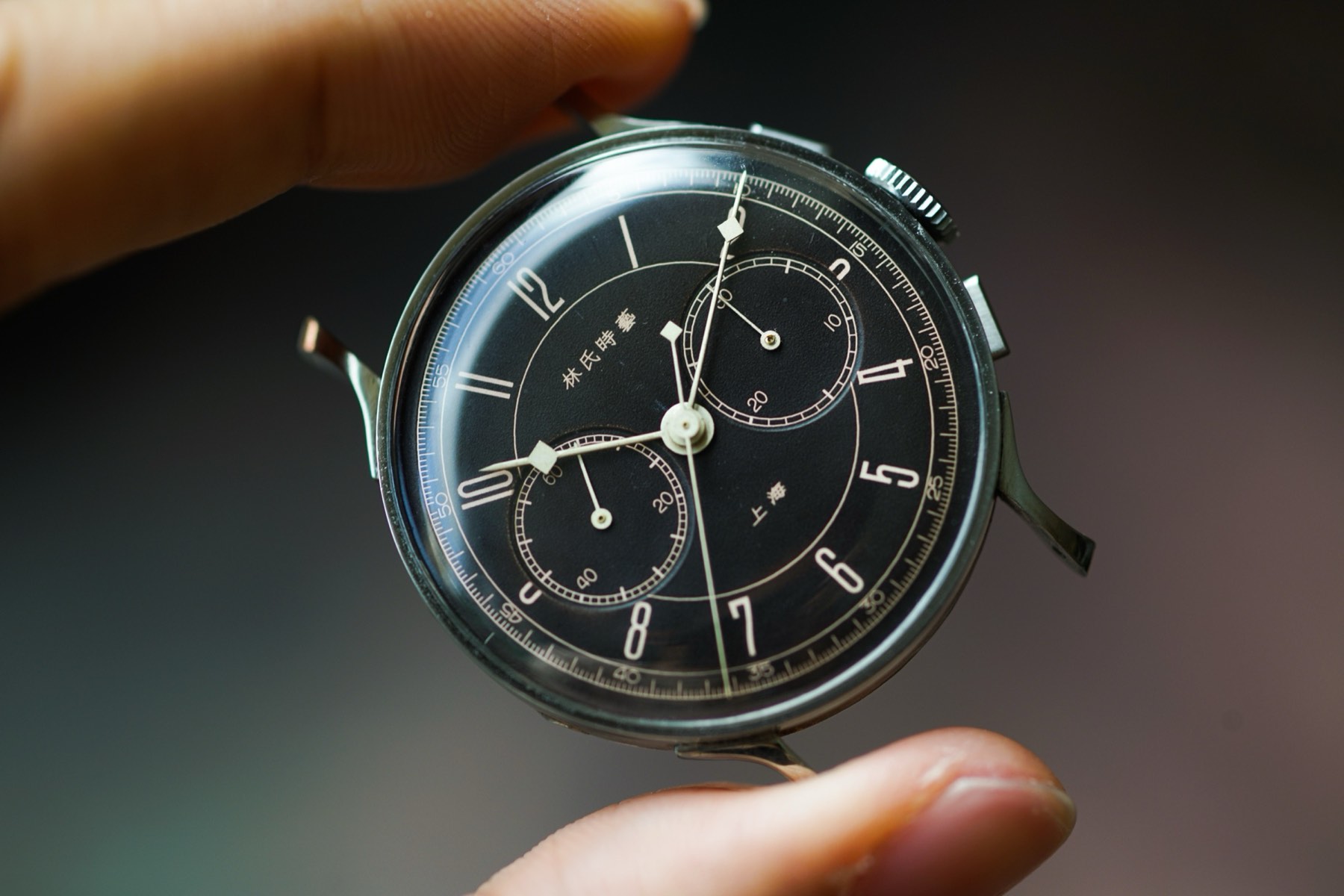
For the dial I kept returning to watches from the 1930s and 1940s, and in particular to a gold Doxa whose numerals had the character I was looking for. I did not want theatrical nostalgia, nor the clinical perfection of a modern typeface. The numerals needed to carry the modernism and cityward optimism of their own period: tall, lean and slightly strange.
The hands were not bought as finished components. Each one was machined by hand and then painted in a yellow-brown tone rather than a perfect white; the dial printing was matched to it. The colour suggests age without trying to imitate damage. Mr. Guo designed the hands with geometric tips that do not belong to the usual vocabulary of chronograph batons, leaves or sticks. Their unfamiliarity became one of the watch's signatures, and the shapes converse naturally with the long numerals.
Several dial variations were printed. One version felt too empty at the centre, but another conventional track would have competed with the seconds scale already running around the edge. The answer was a fine inner ring: enough to hold the composition together, but not so descriptive that it became another scale. The finished dial is dense at the perimeter and calm at its centre, with the two registers occupying the space the movement gives them rather than pretending to sit somewhere else.
05 / Making the watch
The unnecessary part.
Near the end of the build, the column wheel began to bother me. Mechanically it was exactly what it needed to be, but visually it felt rough beside the rest of the watch. The solution came from early twentieth-century pocket watches, where one sometimes finds a highly polished cap placed above the column wheel. It serves no essential chronograph function. At most, it offers a little protection from debris. Its real purpose is generosity: someone chose to make beautiful a part that did not need help to work.
I contacted DG Watches, who had experience manufacturing and polishing components for Lemania movements, and commissioned the small cap. My friend Fredo fitted it during the cleaning and service. It is almost invisible when the officer back is closed and immediately legible when it is opened. That is precisely why it belongs there.
Putting the watch together was slow because fitting is slow. Every fraction of a millimetre affected another part: the movement inside the case, the crystal above the hands, the hinge beneath the wrist, the crown between the pushers. None of these decisions is spectacular by itself. Together they determine whether the watch feels inevitable or merely assembled.
06 / Making the watch
Thirty-three millimetres.
The completed chronograph is 33 millimetres across and approximately 8.2 to 8.3 millimetres thick, including the domed crystal. The metal body accounts for about seven millimetres. The lugs accept an 18-millimetre strap, tapered here to 14 millimetres. On my 15-centimetre wrist, it sits with the balance I had been trying to find from the beginning.
The Lemania offers roughly 36 to 40 hours of power reserve, so winding it becomes a small ritual every other day. Because the watch is light, thin and compact, it can go almost anywhere. That everyday ease matters more to me than the heroic language usually attached to a chronograph.
The Chinese phrase 三十而立 is often translated as ‘at thirty, one stands.’ It does not mean that life is complete at thirty. It means that responsibility can no longer be deferred: one has reached the age at which a life must be given its own structure. I made this watch to mark that threshold. The chronograph measures short intervals, but the caseback asks me to consider longer ones. I hope to wear both reminders for the rest of my life.
The finished watch
Built to be worn.
- Movement
- Lemania 2310 / hand-wound column-wheel chronograph
- Case
- 3D-printed steel / hand-fitted officer back
- Diameter
- 33 mm
- Thickness
- Approx. 8.2–8.3 mm including crystal
- Lug width
- 18 mm / strap tapering to 14 mm
- Power reserve
- Approx. 36–40 hours