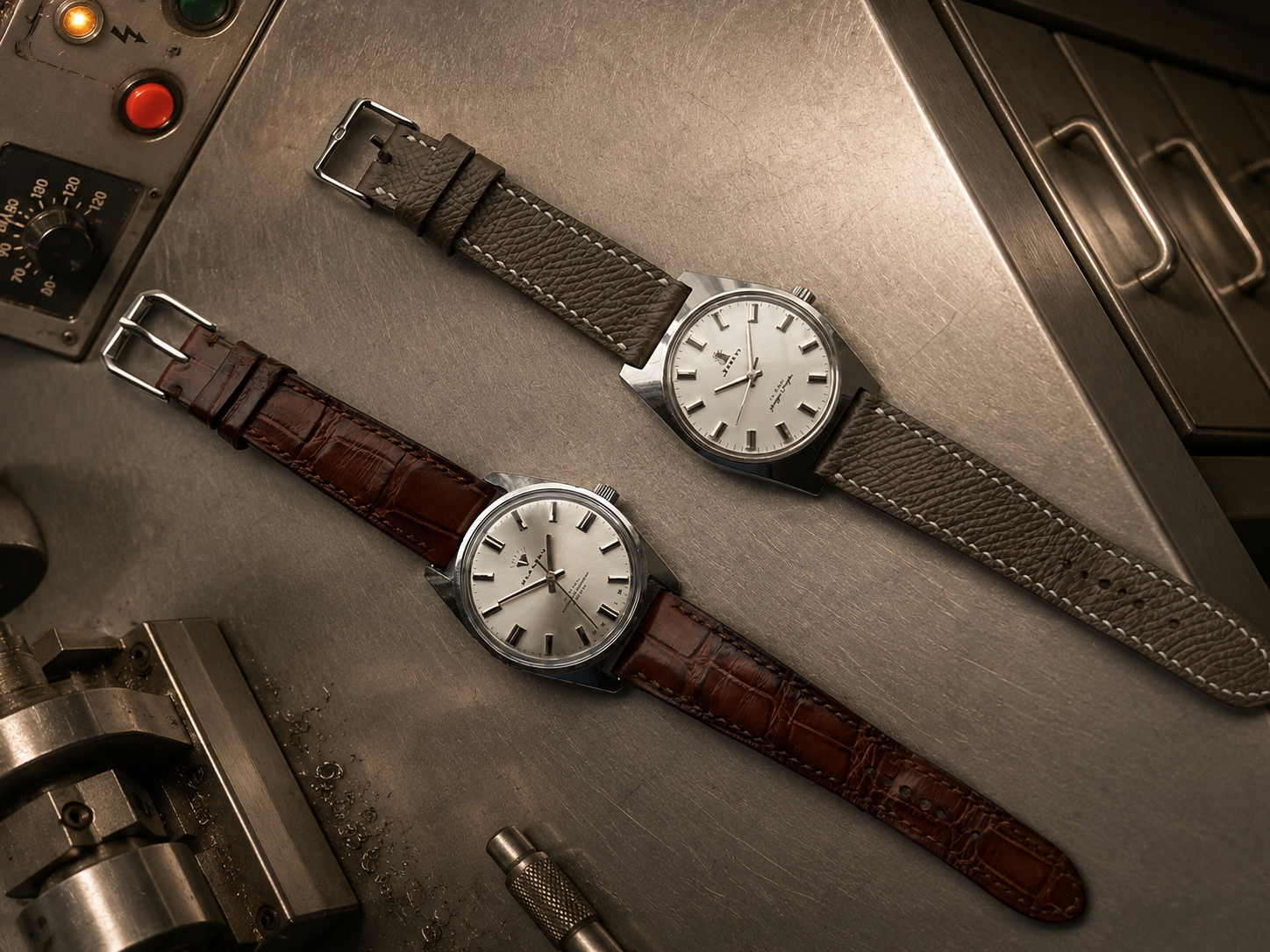
Piece E / Collection photographThe Jinji and ZhuanShi
The pairMy grandfather, factory period
In the spring of 1974, my grandfather received a small printed ticket from the . It was not money. It was permission—a purchase coupon, issued by the work unit, conferring upon him the right to buy one wristwatch. He had worked at the plant for nearly twenty years, since he was a young man not much older than a boy. He was thirty-eight years old that spring, and a new wristwatch bought with his own ticket had always seemed to belong to other men—foremen, officials, men whose work did not leave grease under their nails.
The envelope arrived without ceremony, delivered to his workbench by a clerk who set it down between a micrometer and an oil can. It was thin, pale blue, typed with his name and the characters of the factory. He did not open it immediately. He wiped his hands on a rag, then on his trousers, and only then lifted the flap. Inside lay a single slip of paper, smaller than his palm. He read it twice. Then he folded it along its original crease, tucked it into the inner pocket of his jacket, and resumed work as though nothing had happened. But his left hand drifted twice to his chest that afternoon, pressing the shape of it through the cloth.
That night he told no one. Not his wife, not his children. The ticket was not a secret; it was a private weight. In an economy where goods were allocated rather than sold, where money alone could not open the glass cabinet, the ticket was proof that his labor had been seen. It had not been applied for. It had been conferred—earned through years of grease, noise, and precision at the third diesel plant. A watch bought new, with a ticket earned by his own hands, had always seemed to belong to other men. He had repaired engine blocks, calibrated injectors, and read micrometers until his eyes ached, but time itself had always belonged to someone else: the factory siren, the shift foreman, the clock above the main gate. Now, at last, he held the right to carry it on his wrist.
For two weeks he did not go to the store. He told himself it was because the factory was behind on a shipment, because the weather was poor, because the tram was crowded. The truth was simpler and harder to name. He was afraid the watch would not live up to the years of wanting. He kept the ticket in his inner pocket and felt its crisp edges whenever he reached for a wrench or a file. In the evenings, after dinner, he would sit by the window and turn it over in his fingers, not reading it, just holding it. A thing waited for is a thing already owned, he thought, and he was not ready to trade the waiting for the having. He was thirty-eight years old, and he had spent nearly twenty years in the noise of the diesel plant, and still he was not ready.
Dial detailWith the family, 1960s
Case and crownScanned from the family archive
Then, on a gray Tuesday in early spring, he put on his cleanest shirt—still a work shirt, but pressed—and took the tram to the state department store on Nanjing Road. He did not tell anyone where he was going. He stood on the tram with one hand on the overhead rail and the other pressed flat against the ticket in his pocket, feeling its smallness against his palm. The city passed outside the window: bicycles, banners, the low brown buildings of the district. He had seen it a thousand times. That morning it looked different, as though the streets themselves had been waiting for him.
The store was a long room with high ceilings and fluorescent lights that buzzed faintly, like insects behind glass. The air smelled of cheap cologne and floor wax. The watch counter stood at the far end, a slab of glass under which a dozen timepieces lay on dark blue cloth, their hands all frozen at different hours, as if each one had stopped at the moment its owner had abandoned it. Behind the counter a woman in a white collar and dark vest stood with her hands folded, expressionless, official.
He approached slowly, removing his cap. “I have a ticket,” he said. His voice came out lower than he intended.
She extended her hand without speaking. He gave her the envelope. She inspected it, checked a ledger, and then nodded once. “Which model?”
He had rehearsed the answer for two weeks. Now his mouth went dry. “The Jinji,” he said. “The steel one.”
She unlocked the cabinet and removed a tray. The watch lay on a small padded square, its steel case catching the fluorescent light. He did not pick it up. He looked at it the way a man looks at a door he has been walking toward for a very long time. It was smaller than he had imagined, and plainer. But it was whole. The dial was silver-white, the hands were blue-black, and the second hand was still. He wanted to see it move.
“May I wind it?” he asked.
She inclined her head.
He reached into the tray and lifted the watch. The case was cold in his palm, heavier than its size suggested. He turned it over once, slowly, examining the caseback, the lugs, the crown. Then he placed his thumb and forefinger on the crown and twisted. The mechanism resisted for a moment—a tight, mechanical reluctance—and then gave. The gears caught. The second hand began its small, steady sweep across the dial.
He raised the watch to his ear. The sound was not loud. It was a rapid, even ticking, like rain against a window, or the pulse of a small animal held in the hand. He stood there, in the fluorescent light of the state store, holding a machine that had been built in Shanghai by men he would never meet, and it was ticking for him. Not for the factory, not for the foreman, not for the siren that governed his days. For him.
He did not smile. He swallowed once, hard, and lowered the watch.
“I’ll take it.”
The woman wrote out a receipt. He paid—sixty-five yuan, more than half a month of his wages, counted out in folded notes he had saved over the previous autumn. He watched her place the watch in a small cardboard box, then wrap the box in brown paper. She handed it to him across the counter. He took it with both hands.
Movement sideAt the Shanghai No. 3 Diesel Engine Factory
After thirty yearsMy grandfather, wearing the watch
Outside, the city was still Shanghai. The air was gray and cold, and the tram bell rang at the corner, and a man selling roasted yams called out in a hoarse voice. Nothing had changed. And yet everything had. He walked toward the tram stop with the box under his arm and then, halfway there, stopped beneath a plane tree. He unwrapped the box carefully, removed the watch, and strapped it onto his left wrist. The steel was cold against his skin. He turned his wrist once, slowly, watching the light move across the dial. Then he buttoned his cuff over it and walked on, his arm swinging a little differently than before.
That was the watch. That was the Jinji. It was not rare, not precious, not complicated. But it had been earned in a way that no modern purchase can be earned. He is still wearing one in the photograph today.
History
The Jinji — 金鸡, Golden Rooster
The was established in 1955, assembled from a network of clockmakers, repairmen, and small industrial workshops that had been operating independently across the city. The goal was straightforward: to build a domestic watch industry capable of producing precision timepieces at scale. By 1958, the factory had achieved a significant milestone with China’s first fine-movement wristwatches, and the Jinji was introduced as its second-line brand.
The Jinji was powered by a hand-wound movement developed in-house, a direct derivative of the factory’s early standard calibers. It operated at 18,000 vibrations per hour, a modest beat rate by Swiss standards but appropriate for the manufacturing capabilities of the period. The movement was built around a traditional lever escapement with a steel hairspring and a bimetallic balance wheel, configured for manual winding with a crown at three o’clock. Power reserve was approximately 36 to 40 hours on a full wind. The bridges were machine-finished, the plates were stamped rather than milled, and the screws were standard carbon steel. There was no decorative finishing of any kind. The movement was designed to be assembled quickly, maintained easily, and replaced cheaply if necessary.
The typical case was 半钢 — bàn gāng, “half steel” — a brass or copper-nickel-zinc alloy electroplated with chrome to read as stainless. Full stainless existed, but it was reserved for higher-priced models and export. Dimensionally the two were the same: 34 to 36 millimeters across, an 18-millimeter lug width, a screw-down caseback, and a domed acrylic crystal. After decades of wear the chrome goes first at the edges and corners, and the warmer base metal shows through. That is not damage. It is the material record of the watch’s working life.
The dial was silver-white with applied steel indices and a printed minute track. The hands were polished steel, dauphine or baton depending on the production year. The Jinji name sat on the dial in Chinese characters, often with a rooster motif, and on some export models in Romanized text as well. Water resistance was atmospheric only, and the crown had no guards. This was a watch for a city and a factory floor, not for sport or water.
The Shanghai Watch Factory produced the Jinji in large quantities throughout the 1960s and 1970s, and it became one of the most commonly seen wristwatches in China during that era. It was distributed through state-run channels, allocated by work units through the purchase-ticket system, and sold at a price that made it a significant but attainable purchase for a skilled worker. By the mid-1970s, when my grandfather bought his, the model had been in production for nearly two decades and had undergone several incremental revisions. The movement had been updated with improved alloys and tighter manufacturing tolerances, though the basic architecture remained unchanged.
The Jinji was never intended to compete with imported Swiss watches. It was built to provide reliable timekeeping to a population that had limited access to foreign goods and no domestic alternative. In that sense, it succeeded completely. The watches ran, and they ran for decades.
The ZhuanShi — 钻石, Diamond
The ZhuanShi came from a different factory and a different tradition. The had been founded as the Daguangming Clock Factory (大光明钟表制造厂) in 1952, and for its first two decades it specialized in timing instruments—stopwatches, precision chronographs, and devices for scientific and industrial measurement. The transition to wristwatch production came later, and the Diamond line was the result of that expansion.
The movement that powered the ZhuanShi was a direct descendant of the factory’s stopwatch calibers, and it carried some of that instrument-making DNA in its design. It was a hand-wound movement operating at 18,000 vibrations per hour, with a standard lever escapement and a monometallic balance. The plates and bridges were slightly more refined than those of the Jinji, though still firmly in the realm of industrial production. There was no hand-finishing, no chamfering, no decoration. But the tolerances were held to a standard that reflected the factory’s background in precision timing instruments. The power reserve was approximately 38 to 42 hours.
The ZhuanShi was offered in both 半钢 (bàn gāng, half steel) and 全钢 (quán gāng, full steel) — with the full-steel versions priced a little higher and made in smaller numbers. The stopwatch factory held tighter case tolerances than the general wristwatch plants, and the chrome on half-steel examples was generally thicker. My grandfather’s watch shows the usual half-steel wear: plating still bright on the bezel and flanks, worn through to a dull gold at the lug tips and caseback edges where it met work surfaces for thirty years. The case was typically 34 to 35 millimeters, with a snap-on caseback and a domed acrylic crystal.
The dial was silver or pale champagne, with applied indices and a printed minute track. The hands were dauphine, polished steel. The ZhuanShi name sat in Chinese characters, sometimes with an English “Diamond” signature on export models. The crown was at three o’clock, unprotected. Water resistance was minimal.
The ZhuanShi was positioned slightly above the Jinji in the domestic market, reflecting the stopwatch factory’s reputation for precision. It was still very much a working person’s watch, allocated through the same ticket system and sold at the same general price point of 60 to 70 RMB. But it carried a subtle distinction, a suggestion that its owner had chosen something with a touch more refinement, a watch whose lineage ran through stopwatches and timing instruments rather than mass-produced industrial calibers.
Shared Industrial Context
Both watches were products of the same economic and technological environment. China in the 1960s and 1970s was still assembling a precision-manufacturing base, and the watch industry was a priority sector precisely because it demonstrated the ability to produce complex mechanical devices at scale. The calibers used in the Jinji and ZhuanShi were not designed by individual watchmakers or ateliers. They were designed by engineering committees, tested in state laboratories, and produced in factories that employed thousands of workers across dozens of production lines.
The quality of these movements was uneven by modern standards. Materials science was still catching up to the demands of precision timekeeping. Hairsprings were subject to metal fatigue. Pivots wore faster than their Swiss counterparts. Lubricants degraded more quickly in high-temperature environments. Accuracy out of the factory was typically measured in minutes per day, not seconds, and regulation was performed at the factory under controlled conditions that bore little resemblance to the reality of a factory floor.
Yet the watches endured. The Jinji and ZhuanShi movements were over-engineered in the places that mattered—wheel train pivots, mainspring barrels, escapement geometry—and under-engineered in the places that did not. They were built to survive neglect, rough handling, temperature swings, and long intervals between servicing. Many of these watches were never serviced at all during their working lives. They were wound until the crown felt loose, worn until the crystal went opaque, and then handed down or put away. A remarkable number of them are still running.