Collection / Piece JRef. 27.0030.398

A Complete Calendar From the Quiet Years

Zenith
Ref. 27.0030.398.

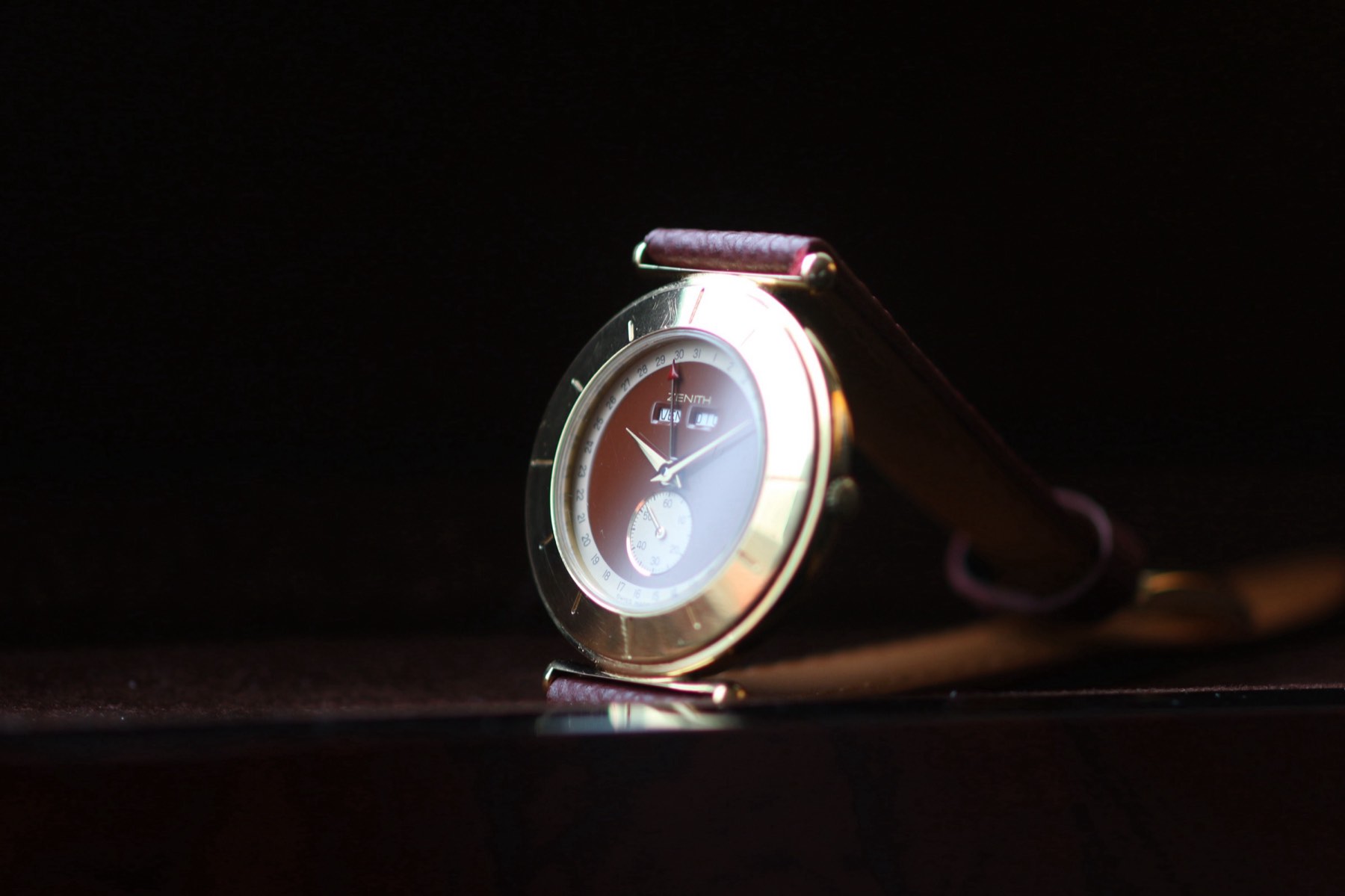
A c. 1990 Zenith quartz complete calendar, reference 27.0030.398 — pointer date read by a red-tipped central hand, day and month in twin apertures, small seconds at six, and a gold-tone case that wears like a disc.

Zenith reference 27.0030.398 complete-calendar dress watch photographed from the front
Primary archive image / IMG_2141Piece J / Collection photograph

Complete calendar · pointer date · Swiss quartz

Why a quartz
Zenith deserves
a record.

Every watch collection eventually acquires a straggler.

The one in the photographs is a Zenith reference 27.0030.398: a quartz dress watch from about 1990 that, on the surface, has almost nothing to do with everything people think they know about Zenith. No El Primero. No chronograph. No column wheel. Just a battery, a wide gold-tone case, a two-tone brown-and-salmon dial, and a calendar that refuses to behave like a normal calendar.

And yet it is one of the most quietly interesting watches in the archive.

It is interesting for exactly the reasons the modern market tells you it shouldn't be. It is quartz when collectors want mechanical. It is plated when collectors want solid gold. It is genuinely scarce, and still relatively inexpensive. It comes from a period the brand's own enthusiasts skip over.

This is its record.

01 / Identified

Reference 27.0030.398, circa 1990. A quartz complete calendar with pointer date and subsidiary seconds. The identification rests on a preserved NOS listing of the identical dial; the exact calibre remains to be documented from the movement.

02 / Why it remains

A pure product of post–quartz-crisis Zenith: electronics hidden inside the costume of a nineteenth-century complication. A watch most collectors pass over, and one the archive is glad it kept.

03 / Inside

A Swiss quartz complete-calendar movement, calibre yet to verify. One clear movement photograph, plus the caseback markings, would settle the last open questions.
01

The Watch That Isn't the Watch

Ask most collectors what Zenith is, and the answer comes back in a single word: El Primero. The integrated chronograph of 1969. The movement reputed to have gone to the moon. Zenith's modern reputation rests almost entirely on its great automatic chronograph.

That reputation has a blind spot.

During the 1970s and 1980s — the years of the quartz crisis and the consolidation that followed — Zenith, like the rest of the Swiss industry, produced a very large number of quartz watches. Thin, discreet, and inexpensive, they occupy the margins of the brand's catalogue while the mechanical chronograph family sits at the centre. They are the pieces the brand's own enthusiasts quietly choose not to discuss.

The watch under discussion belongs squarely in that gap.

It is a Zenith. It is Swiss. It dates to about 1990. And it demonstrates that the design department was paying close attention during exactly the period collectors prefer to skip over.

02

What It Actually Is

Calling this watch a "date watch" would be doing it a disservice.

It is a complete calendar — in the older vocabulary, a triple calendar: day, month, and date displayed simultaneously. Zenith's way of displaying that calendar is the reason the watch is interesting at all.

The timekeeping is conventional — central hour and minute hands. The seconds are not. Instead of a central seconds hand there is a small subsidiary register at six o'clock, the kind of thing you expect on a hand-wound dress watch from 1958.

The date is the theatrical part. A long central black hand with a red triangular tip sweeps a printed 1–31 scale around the chapter ring, pointing at the date the way a gauge points at a measurement. Day and month appear through two rectangular apertures directly beneath the Zenith signature.

Read the watch in the photographs and you will find it set to roughly Friday, December 30: VEN for *venerdì* — Friday, in Italian — DIC for *dicembre*, with the pointer near the 30.

One qualification matters: this is a conventional triple calendar, not an annual or perpetual calendar. Unless evidence from the movement proves otherwise, the wearer has to correct the date after every month shorter than 31 days. That is not a defect. It is the normal price of admission.
03

The Identification, and Where It Came From

The identification of this particular watch rests on an unusual piece of evidence: not a catalogue, but an archive of secondary-market listings.

An EveryWatch archive preserves a Chrono24 listing for an apparently identical watch: a Zenith Triple Calendar N.O.S., reference 27.0030.398. The archive dates it to approximately 1990, and gives a 33 mm case, a quartz movement, an Italian calendar, a leather strap, small seconds, and day/date/month indications.

What makes that listing persuasive is the configuration. A description like "date watch" would match any of a thousand Zeniths. "Triple calendar with pointer date and subsidiary seconds" matches this dial and almost nothing else.

The unusual details line up one by one: the very broad, circular polished gold-tone case; baton hour markers mounted on the broad outer surround rather than the central dial; the extremely short bar-style lugs at twelve and six; the brown/salmon central dial; the white 1–31 peripheral calendar ring; twin rectangular day and month apertures immediately below ZENITH; the central black date hand with its red triangular pointer; the white small-seconds register at six; gold dauphine-style hour and minute hands; even a tiny crown set within the right side of the case.

The preserved NOS example is especially useful because the seller claimed it was completely original — including its Zenith lizard strap and gold-plated buckle — and still retained its original tag and the blue protective film on the caseback.

That combination is distinctive enough that 27.0030.398 should be considered the correct reference unless an engraving inside the case contradicts it.

04

Three Concentric Dials at Once

Study the dial for a moment and you will notice the watch is really three dials stacked on top of each other.

The outer layer is the polished gold-tone surround where the hour markers live. Notice that the central dial carries no conventional hour indices at all. Zenith pushed the hour furniture outward onto the broad surround, which makes the visible dial opening appear much larger than the case really is.

The middle layer is a white chapter ring printed with the 1–31 date scale. Because the scale sits in its own ring, Zenith could devote an entire central hand to the date without compromising normal time reading.

The inner layer is the brown/salmon centre: the Zenith signature, the twin day-and-month apertures directly beneath it, and the small-seconds register anchoring the lower half. The result has strong vertical symmetry above and below the centre.

This is not guilloché. It is not elaborate finishing. Whatever visual pleasure the watch offers comes from its information architecture — information arranged so clearly that a stranger can read a century's worth of date indications at a glance.

05

The Small Seconds, and the Mechanical Disguise

Quartz watches use a central seconds hand because it is mechanically simple and because it reassures the wearer that the watch is running.

Zenith instead placed the seconds at six.

That single decision does two things. First, it frees the centre of the dial for the pointer date. Second — and more importantly — it deliberately makes the watch resemble a traditional hand-wound complete-calendar watch.

Try the experiment: cover the word QUARTZ at the bottom of the dial and hand the watch to someone who has never seen the reference. Most would assume it contained a mechanical movement.

That was almost certainly intentional. This is the second stage of Swiss quartz: not an attempt to beat Seiko at making the most futuristic electronic watch on earth, but an attempt to use quartz to make an elegant, thin, complicated-looking classical wristwatch. The visual language is nearly nineteenth-century — pointer date, day and month, small seconds — with an electronic heart beating underneath.

That juxtaposition is the whole point.

06

Dating a Quiet Dial

The working date for this example is approximately 1990 — the year the exact-reference archive gives for the model, and the period its styling supports.

Consider the evidence on the wrist: very thin dress proportions, a broad polished gold-tone case, minimalist applied baton markers, a brown/salmon dial, twin rectangular apertures, and a quartz watch that uses small seconds as a deliberate mechanical cue.

Stylistically this is a transitional object. Early in the quartz era, Swiss manufacturers treated electronics as futuristic technology and said so proudly. By the end of the 1980s they had quieted down: quartz movements were increasingly hidden inside watches styled to resemble classical complicated mechanical watches.

This Zenith is precisely that object — a quartz complete calendar wearing the outfit of a nineteenth-century complication.

07

The Reference, Decoded

Zenith reference numbers of this period reward the effort of looking at them twice.

The archived listing states the reference on this watch as 27.0030.398 — a NOS example of the same configuration, which the seller described as a Triple Calendar. The number is therefore far firmer than a seller's guess: an apparently identical, fully original example carried the same reference.

A period catalogue could confirm it, and an engraving inside the case would settle it outright. But the evidence now supports calling this watch Zenith Ref. 27.0030.398 with confidence — the number appears in a preserved listing that matches the unusual dial in every detail this record can compare.

08

Gold Without Being Gold

This watch looks like gold. It is very probably not.

The archived listing is even internally inconsistent on the point: EveryWatch's normalized metadata reads stainless steel, while the original seller's own description says gold-plated — case and bezel both. Those two readings can both be true of a gold-plated case with a stainless-steel back, a common construction for watches of this type, but this record will not turn that inference into a fact.

What can be said safely is this: it is not a solid-gold Zenith. The visible case is gold-plated/gold-tone, with steel likely involved in the case construction. There is no evidence of an 18-karat case.

As for size, the exact-reference listing documents the case at 33 mm — modest even for its time. Because the lugs are extremely short and largely hidden behind the broad circular case, the watch wears less like a traditional lugged dress watch and more like a disc. That is a look that was fashionable at the transition from the 1980s into the early 1990s — and, it turns out, quietly timeless.

09

What's Underneath

Here is the honest part, and it deserves to stay honest.

The archived listing identifies the watch, but not the movement, and this record will not guess. It says Swiss quartz and no more. There are several Swiss calendar-quartz movement families from this period that could produce this display combination, and Zenith also used movements carrying its own calibre designations. Claiming "ETA or ESA xxxxx" based on the dial alone would be fabrication presented as scholarship.

Solving it is straightforward. One clear photograph of the movement — plate architecture, coil position, battery location, calendar works, diameter, and the stamped calibre — would almost certainly settle it. A photograph of the caseback would help as well, because Zenith commonly stamped identifying information there.

Until then, the correct answer to "what's inside?" is: a Swiss quartz complete-calendar movement, calibre to be verified.

10

Rare Is Not the Same as Expensive

This watch is genuinely uncommon. Searches for the exact reference turn up only a handful of examples, while Zenith's better-known quartz families — Surf, Espada, Cosmopolitan, Defy, Port Royal — appear far more frequently.

But rare does not mean expensive.

The market prices Zenith's mechanical watches, particularly the El Primero, far more aggressively than its obscure quartz output. The result is a fascinating inversion: a watch that is genuinely scarcer than many five-figure Zeniths, at a price anyone can reach.

What the archive does preserve is a NOS example of this very reference, described as completely original and still wearing its original lizard strap, tag, and caseback film. A complete, unspoiled example of an uncommon reference is the sort of thing that rewards patience.

The scarcity justifies patience. It does not justify a four-figure premium, and nobody should pay one merely because the watch is rare.

11

Specifications — Zenith Ref. 27.0030.398

Manufacturer
Zenith, Le Locle, Switzerland
Reference
27.0030.398
Description
Triple / complete calendar quartz
Period
c. 1990
Diameter
33 mm, per exact-reference listing
Movement
Swiss quartz; exact calibre to verify
Functions
Hours, minutes, small seconds, day, month, pointer date
Calendar type
Complete / triple calendar, conventional rather than perpetual
Date
Central black pointer with red tip, 1–31
Day / month
Twin apertures beneath the signature
Calendar language
Italian discs (VEN = venerdì; DIC = dicembre)
Seconds
Subsidiary at 6
Case
Gold-plated/gold-tone, steel likely involved; not solid gold
Strap
Leather (NOS example had an original Zenith lizard strap)
Made
Switzerland
Collectability
Scarce, currently under-collected
12

The Case for Keeping It

The easy arguments for this watch are the sentimental ones. It is unusual, it is honest, it is unlikely to be replaced, and it photographs beautifully.

The better argument is historical.

Zenith today means El Primero. But for a generation, the company survived the quartz revolution and its aftermath partly by making watches exactly like this one — careful, elegant, slightly complicated, and entirely at the mercy of a battery. That era happened. It is as much a part of Zenith's story as the moment in 1969 when an integrated automatic chronograph was born.

A wrist-worn object from that period carries the evidence better than any history book.

Look at it once more. Two apertures under the signature. A white date ring. A red-tipped hand. Small seconds at six, pretending it is powered by springs. A future in which Swiss luxury watches became electronically regulated machines wearing mechanical disguises never fully arrived; history chose a different route.

But this watch tried that route, and it still fits on the wrist.

That is why it remains in the collection, and why it now has a proper record.

Record

Zenith, Le LocleRef. 27.0030.398c. 1990Triple / complete calendar quartzPointer date · day · monthSmall seconds at six33 mm caseItalian calendar
Back to all collection records →