The 1903 Pocket Watch Behind It
Jean d’Eve Sectora
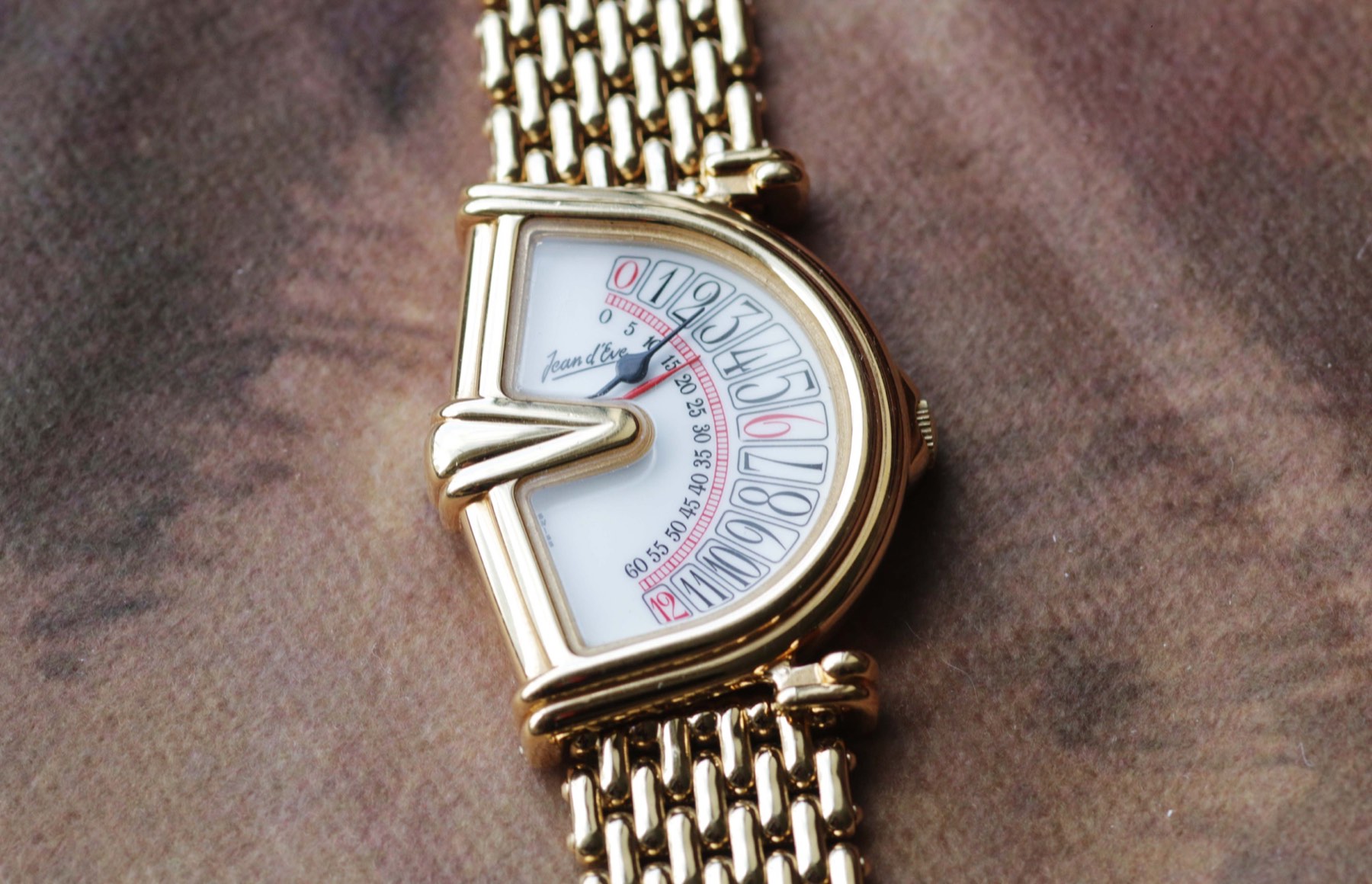
A large-format gold-tone Jean d’Eve Sectora with a white dial and an integrated articulated bracelet, showing the coaxial double-retrograde hours and minutes that define the family.
1903 patent · fan-shaped pocket watch · 1980s quartz revival
Place the Jean d’Eve Sectora on a table and almost everything about it says 1980s. There is the gold-tone integrated bracelet, the polished asymmetric case and the white dial sliced into two coloured arcs.
Then the minute hand reaches the end of its track. It snaps back to zero and starts again. The hour hand performs the same trick after reaching 12.
The case may be pure late-twentieth-century exuberance, but the display is much older. Its story starts with a silver pocket watch patented more than 80 years before this Jean d’Eve was made.
The Sector Watch
The Sector Watch
In June 1903, the Turin inventor Giovanni Sgherlino filed an American patent for a clock or watch whose two hands travelled across an arc before returning suddenly to their starting positions.
The surviving patent drawings show a mechanism constructed around toothed sectors, specially shaped wheels and return springs. The minute hand travels to 60 and flies back to zero. The hour hand does the same after reaching 12. The patent was granted in the United States in May 1905, following Swiss patent No. 27,961.
Record Watch Co. was organized in Tramelan in 1903 around putting Sgherlino’s invention into production. The resulting Sector Watch was unlike an ordinary pocket watch in almost every respect.
Its silver case was shaped like a fan or section of a circle. The white enamel dial followed the same outline, with hours running from 0 to 12 and minutes from 0 to 60. The movement was shaped to fit the case rather than placed inside a conventional round shell.
Many cases were supplied by Holy Frères of Saint-Imier. Surviving examples have floral Art Nouveau ornament, niello decoration and elaborate relief scenes depicting dancers, hunters, horses and romantic figures. Behind the decorated cover is a hinged silver cuvette, usually engraved “Sector Watch.”
The watch is occasionally described in dealer and auction copy as a jump hour. That terminology is misleading. A true jump-hour watch presents the hour as a numeral on a moving disc. The Record has an hour hand. What jumps is the hand’s return to zero, making it a double-retrograde display rather than a digital jump hour.
An April 1996 article in Horological Times included photographs of one example and a response from the watchmaker Henry B. Fried. Fried wrote that he had repaired numerous Sector watches and warned of the damage caused by watchmakers unfamiliar with the under-dial mechanism.
Auction appearances confirm that several case variations survive. A decorated example sold at Antiquorum for CHF 5,250 in 2012; Heritage sold another for $3,500 in 2016; and Auktionen Dr. Crott sold an example with a runaway-horse scene for €5,500 in 2022.
From A Pocket Watch To The Wrist
From A Pocket Watch To The Wrist
The Record disappeared, but the sector display did not.
During the early 1970s, the idea returned in wristwatches including the Wittnauer Futurama and LIP Secteur. These watches placed retrograde hour and minute hands over elongated displays and used shaped cases to accommodate the mechanism.
Collectors and dealers frequently describe the Wittnauer as a jump hour too. Again, the watch actually uses retrograde hands. Its automatic ETA 2784 drives a module with shaped cams and spring-loaded followers.
Le Phare took the idea in another direction. Historical research drawing on Dubois-Dépraz archives records a Le Phare Sectora in 1973, using a Dubois-Dépraz complication developed with the Record Sector Watch as its inspiration.
Europa Star photographed the Le Phare Sectora at the 1974 watch fair. Unlike the horizontal Record and Wittnauer displays, its scale was placed upright, with 12 at the top. The broader 150-degree arc made it easier to read like a conventional watch.
Le Phare redesigned it again in 1976. The resulting watch is now nicknamed the space helmet because most of the dial disappears beneath a large metal structure, leaving only the ends of the scales visible. Contemporary coverage described the hands sweeping from left to right and snapping back automatically.
Jean d’Eve Brings It Back Again
Jean d’Eve Brings It Back Again
Le Phare and Sultana combined during the 1970s. Jean d’Eve emerged as the group’s modern, quartz-focused identity during the following decade.
By 1986, the Sectora had returned under the Jean d’Eve name. The company’s own fair material presented it as a successful display from the beginning of the twentieth century, now revived with quartz technology. Jean d’Eve was not pretending it had invented the arrangement. It was selling the return of an old idea.
The movement architecture had changed, but the basic performance remained familiar. A quartz oscillator regulated the watch while gears, cams and springs converted its rotation into the motion of the retrograde hands.
The case was entirely new. Its upper half follows the arc of the dial, while the lower section closes around the hands’ central axis like a stylized shell. Instead of hanging from a pocket-watch bow, it flows directly into an articulated bracelet.
The range expanded quickly. In 1987 Jean d’Eve showed a smaller women’s Sectora alongside the men’s model. Contemporary material records gold-plated, solid 18-karat-gold and diamond-set cases, with a calendar offered on the men’s version. Sectoras remained in the fair record in 1989.
The Watch Here
The Watch Here
This large-format Sectora uses a white dial with a black hour scale and red minute track. The colours perform an important practical function: without them, two coaxial hands travelling over adjacent arcs would be considerably harder to separate at a glance.
The large gold structure over the centre hides the hands’ common axis and gives the case its most recognizable feature. The articulated bracelet continues directly from the case, with alternating polished and brushed surfaces and a clasp carrying Jean d’Eve’s mirrored monogram.
The visual relationship with the Record pocket watch is not a literal copy. The Jean d’Eve has rotated, compressed and industrialized the idea. Yet the family resemblance is difficult to miss: a case derived from a sector, two scales following the same arc and two hands that refuse to travel in circles.
That is what makes this Sectora more than an unusual quartz watch. It carries a display invented in Turin, turned into an Art Nouveau pocket watch in Tramelan, revived mechanically by Le Phare and Dubois-Dépraz during the 1970s, and returned once more under Jean d’Eve in the 1980s.
The bracelet, finish and styling belong to their decade. The idea underneath them belongs to 1903.
At A Glance
At A Glance
- Watch
- Jean d’Eve Sectora, large format
- Period
- 1980s
- Display
- Coaxial retrograde hours and minutes
- Arc
- Approximately 150 degrees
- Movement
- Swiss quartz with a mechanical retrograde display
- Dial
- White, with black hour and red minute scales
- Case and bracelet
- Asymmetric gold-tone case with integrated signed bracelet
Bound album / Collection study · 13 frames
The complete Jean d’Eve photograph set, arranged as a responsive album. Select any frame to open it at full size.
Large Sectora / front view
Dial and hands / close view
Bracelet / signed clasp
Research record / Patents, archives, auctions and collector forums
What the history
rests on.
- 01
United States Patent Office
Giovanni Sgherlino, Clock or Watch Movement, US 788,797The 1903 filing, 1905 grant, full description and original drawing sheet for the two-hand retrograde mechanism.
- 02
La Fédération Horlogère Suisse
Record Watch Co. period advertisement, 31 August 1905A digitized contemporary trade-journal issue carrying an illustrated Record Watch advertisement.
- 03
Horological Times / AWCI
Henry B. Fried answers a Record Sector Watch owner, April 1996Photographs and a watchmaker’s account of the Sector Watch, its survival and difficult under-dial mechanism.
- 04
Time To Tell
Joël Pynson, The True Story of Fabrique Le PhareA sourced company history connecting the 1973 Le Phare Sectora, Dubois-Dépraz and the Record Sector Watch.
- 05
Europa Star / SwissTime
Le Phare Sectora at the 1974 European Watch FairContemporary photography and fair coverage of Le Phare’s first documented wristwatch execution.
- 06
Europa Star / SwissTime
Le Phare Sectora at the 1976 European Watch FairThe redesigned metal-covered model now known by collectors as the space-helmet Sectora.
- 07
Europa Star / SwissTime
Jean d’Eve Sectora at the 1986 European Watch FairJean d’Eve’s own period presentation of the historic sector display revived with quartz technology.
- 08
Europa Star / SwissTime
Le Phare–Jean d’Eve Sectora, 1987Documents the 150-degree arc, women’s size and plated, solid-gold and diamond-set executions.
- 09
Europa Star / SwissTime
Le Phare–Jean d’Eve Sectora, 1989Confirms the continued men’s Sectora range and records its case-material and calendar options.
- 10
Antiquorum
Record Watch Co. Sector Watch, Geneva, 2012, lot 51A fully catalogued fan-shaped silver example, sold for CHF 5,250.
- 11
Christie’s
Record Sector Watch, circa 1903Auction photography and a concise description of the fan-shaped movement, dial and decorated case.
- 12
Heritage Auctions
Record Watch Co. Art Nouveau Sector Watch, 2016A .800-silver example with patent 27,961, sold for $3,500.
- 13
Auktionen Dr. Crott
Record Sector Watch, 107th auction, 2022, lot 243A Holy Frères example with a runaway-horse case scene, sold for €5,500.
- 14
CrazyWatches
Wittnauer Futurama mechanism and repair studyCollector documentation of a related 1970s double-retrograde module with photographs and animation.
- 15
Relojes Especiales forum
Sector Watch de bolsillo — calibre en corazónCollector photographs and discussion identifying the shaped Record movement and patent marking.
- 16
Foro de Relojes
Record, LIP and Jean d’Eve comparison threadA useful collector comparison of the pocket-watch display with LIP and Jean d’Eve wristwatches.
Record