Valjoux 5 KVMc. 1912–75
19-ligne monopusher chronographEarlier large-pocket generation; not a documented direct parent of the 76.
A personal collection
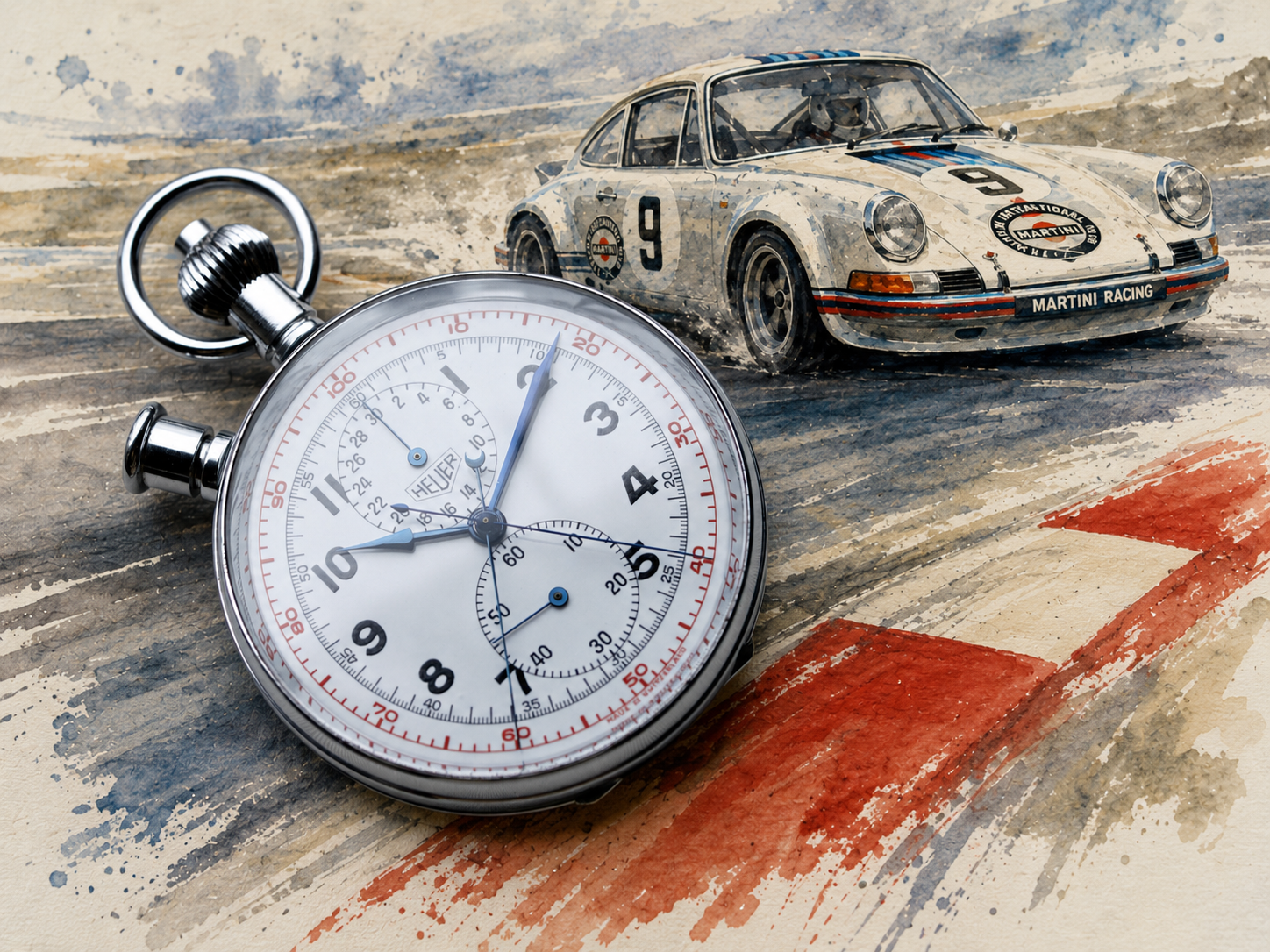
The Collector’s Guide / split seconds
Rattrapante Pocket Chronograph
A split-seconds pocket chronograph built for race timing and intermediate readings.
In-depth / the instrument
Ref. 11.204 · Valjoux 76R · early-to-mid 1960s
The easiest way to misunderstand this Heuer is to call it a pocket watch. It does tell the time, and it was built to be carried, but those facts are almost incidental. Reference 11.204 is a working instrument: a large, hand-wound split-seconds chronograph designed to separate one moment from another without losing the event still unfolding beneath it.
Its scale, pushers and two superimposed chronograph hands belong to a world of lap boards, finish lines and handwritten calculations. The watch sits at an interesting hinge in Heuer history, around the early-to-mid 1960s: the firm was still a major maker of handheld timers, even as names such as Autavia and Carrera were teaching enthusiasts to associate Heuer with the wrist.
01 / Chapter
Long before a racing chronograph became a lifestyle object, timing was an occupation. Coaches, officials, engineers and navigators held stopwatches because a large dial was easier to read quickly and a large case gave the mechanism room to do difficult work. Heuer had lived in this world since the nineteenth century, building its name on chronographs, stopwatches and dashboard instruments.
That distinction matters. A wristwatch accompanies its owner; a timer is picked up for a task. Heuer's 1960 catalogue reset its stopwatch line for athletics, motorsport and industrial use, while the firm's 1962–63 wrist chronographs were only beginning to acquire the model names that collectors now know by heart. The Ref. 11.204 belongs to the practical side of that divide.
02 / Chapter
Start the chronograph and the two long seconds hands travel as one. Press the split pusher and one hand stops, preserving an intermediate reading, while the other continues around the dial. Press again and the arrested hand catches the running hand—rattrape in French—ready to take another split.
The complication solves a very human timing problem. Two cars cross a line at different moments. One runner completes a lap while the race continues. An engineer needs a partial duration without sacrificing the total. A normal chronograph gives one answer and then stops. A rattrapante briefly holds two answers at once.
One hand becomes a memory.The other keeps following the event.
03 / Chapter
This is the Heuer Ref. 11.204 / 11204, a decimal-minutes split-seconds pocket chronograph fitted with the Valjoux 76R. Period-catalogue research places the 112xx family in Heuer's early-to-mid-1960s range, approximately 1963–66.
The reference arrived at a transitional moment. Wrist chronographs such as the Autavia and Carrera were becoming the public face of Heuer, while professional handheld timers still formed the practical backbone of the company. Ref. 11.204 belongs firmly to that instrument-making tradition: a large display, a dedicated rattrapante calibre and controls built for timing work rather than daily wear.
04 / Chapter
The name is unusually revealing. Valjoux 76 is the underlying chronograph; the R is the rattrapante apparatus added to it. A period Bestfit service-material chart makes that relationship explicit: directly beneath “Valjoux 76R—Split Second,” it tells the repairer, “For regular chronograph parts see Valjoux 76.” It then separates the 76R-only material, including its own pillar wheel and fly-back lever. This is not a poetic family resemblance. It is how the movement was serviced.
Published specifications put both 76 and 76R at 19 lignes, or 42.1mm across, with a listed height of 7.45mm, 17 jewels and a frequency of 18,000 vibrations per hour. The ordinary 76 supplies the going train, the conventional chronograph and its column-wheel logic. The 76R keeps that machinery and adds another control problem above it: one central hand must be stopped while the chronograph wheel beneath it continues to turn.
The wider Valjoux catalogue gives the 76R a useful context without pretending that every large calibre forms one documented bloodline. The older Cal. 5 and Cal. 9 belong to Valjoux's earlier 19-ligne pocket-chronograph generation; the Cal. 9 already offered rattrapante timing. After the Second World War, the Heuer-associated 76/76R pair provided a flatter, purpose-specific answer. The 76 is the immediate sibling and parts base. The 9 is an earlier precedent—not the movement inside this watch.
Four large Valjoux calibres / the useful family map
That 42.1mm diameter is not dead space. A broad movement lets the maker use large wheels, long levers and clearly separated control organs; for a repairer, the mechanism reads as a sequence rather than a stack of miniaturised compromises. This is not a wrist calibre made large. It is a pocket instrument whose size is part of the engineering.
05 / Chapter
A rattrapante is easiest to understand at the centre of the movement. The main chronograph hand sits on a hollow arbor. The split hand has its own arbor running concentrically through it. When the mechanism is at rest or running normally, the two hands are superimposed so perfectly that the complication almost disappears.
One split / four mechanical states
The dedicated 76R pillar wheel matters because the split command must be independent of start, stop and reset. One control system runs the chronograph; another opens and closes the rattrapante clamp. That separation is what lets an observer preserve an intermediate time without disturbing the total time still accumulating underneath it.
The hard part is not merely stopping a wheel. It is stopping it cleanly, without shifting the reading, then returning it instantly without dragging down the balance. Adrien Reymond's 1892 split-seconds patent describes the classic difficulty: when the brake jaws lock the split wheel, a feeler rubbing continuously on the moving heart cam creates friction and unnecessary work. His proposed isolator lifted that feeler clear while the split hand waited. The patent is not presented as a Valjoux 76R blueprint; it is the mechanical ancestry of the same clamp-and-heart problem that every traditional rattrapante has to solve.
The glamour is in seeing two times.The craft is in keeping one of them still without disturbing the other.
06 / Chapter
The red decimal scale is the clue that this Heuer was made for calculation as much as spectacle. Instead of forcing an observer to convert seconds into a fraction of a minute, the outer scale expresses one minute as 100 units. Thirty seconds becomes 0.50 minutes; fifteen seconds becomes 0.25. For industrial timing, costing and time-and-motion study, the arithmetic becomes immediate.
Heuer offered dedicated decimal-minute stopwatches as well as full pocket chronographs like this one. The language is consistent: high contrast, a red conversion scale and no decoration that competes with the reading. It is graphic design in service of a calculation.
07 / Chapter
Jack Heuer's own account gives the clearest motorsport setting for a watch of this kind. For the 1962 12 Hours of Sebring, he lent the race organisers twelve Heuer pocket chronographs with split-seconds displays. The Sports Car Club of America used them for the event's official timing. These were not promotional props on a driver's wrist; they were the instruments producing the result.
The surviving account identifies those twelve watches by function, not reference, and the event predates the likely Ref. 11.204 production window by roughly a year. It would therefore be wrong to claim that this exact watch—or even this exact reference—timed Sebring in 1962. What the record does establish is more useful: immediately before the 11.204 appeared, Heuer was supplying split-seconds pocket chronographs as official race-timing equipment.
Sebring explains why the rattrapante mattered. At a finish line, one hand could preserve the instant a car crossed while the other continued for the next arrival. During a twelve-hour race, officials also needed multiple instruments for parallel readings, class positions, lap checks and redundancy. A large decimal dial shortened the arithmetic after every observation. The 11.204's design is the logic of that timing table made portable.
The same distinction applied in rallying. Heuer's dashboard clocks and rally timers travelled inside the car; a full pocket rattrapante belonged with an official at a start, checkpoint or finish. Jack Heuer recalled Sports Car Club of America members buying Heuer rally timers directly from the company's New York office, while Heuer's period range was explicitly organised around motorsport timing. Events such as Sebring, the Monte Carlo Rally and the Tulpenrallye show the world in which instruments like this earned their keep—even where no record ties this individual watch to a named event.
Sebring also changed Heuer's public identity. In the pits, Jack Heuer heard the Rodríguez family describe the Carrera Panamericana. He registered the Carrera name after returning to Switzerland and used it for the wrist chronograph introduced in 1963. The famous wristwatch name was born at a race being officially timed with Heuer split-seconds pocket chronographs. The pocket instrument was not a sideshow to the modern Heuer story; it was already at the timing line when that story acquired its name.
08 / Chapter
Many Heuer split-seconds pocket chronographs have not survived as pocket chronographs. Their valuable Valjoux 76R movements have been removed and refitted into oversized wristwatch cases; dials are often refinished or rotated to suit the new format. Each conversion may preserve a genuine movement, but it dismantles the complete instrument Heuer originally made.
That makes an intact Ref. 11.204 in this condition uncommon before one even considers the details. This example still has its pendant, hinged back, broad decimal dial, original pocket-watch configuration and surviving stickers. Stickers are usually the first things lost to handling, cleaning and service. Their presence turns condition into evidence: this watch has not merely avoided conversion; it has retained fragile traces of how it originally existed.
The rarity, then, is not only the Valjoux 76R. Movements can be transplanted. What is much harder to replace is the complete object around it—and harder still to find one with small, vulnerable details such as these stickers still present. The case is not packaging for the calibre. Together with the dial and movement, it is the historical watch.
Sources / further reading
TAG Heuer
How a split-seconds chronograph worksOfficial explanation of stopping, releasing and reuniting the two central chronograph hands.
Grail Watch Reference
Valjoux 76R calibre recordMovement dimensions, jewel count, frequency, reserve and production-era reference.
TAG Heuer
The Golden Age, 1958–1969Official history of Heuer's 1960 stopwatch range, split-seconds Sebring dashboard timer and motorsport-focused instrument business.
Jack Heuer
The Times of My LifeFirst-person account of lending twelve Heuer split-seconds pocket chronographs to the SCCA for official timing at the 1962 12 Hours of Sebring.
Bestfit Material Instant Guide
Valjoux 76R split-seconds service-material chartService chart separating 76R-specific material and directing repairers to Valjoux 76 for the regular chronograph parts.
United States Patent Office
Adrien Reymond, Split-Seconds Stop Watch, US 474,100Primary 1892 patent text and drawings for the concentric arbors, brake jaws, heart cam and rattrapante isolator problem.
Grail Watch Reference
Valjoux 76 calibre recordSpecifications and production-era context for the 76 beneath the rattrapante layer.
Grail Watch Reference
Valjoux 5 KVM and 9 KVR calibre recordsContext for Valjoux's older 19-ligne pocket-chronograph generation; the linked record also maps related large calibres.
Grail Watch Reference
Valjoux 9 KVR calibre recordSpecifications and chronology for the earlier 19-ligne split-seconds calibre used in other Heuer pocket references.
Record