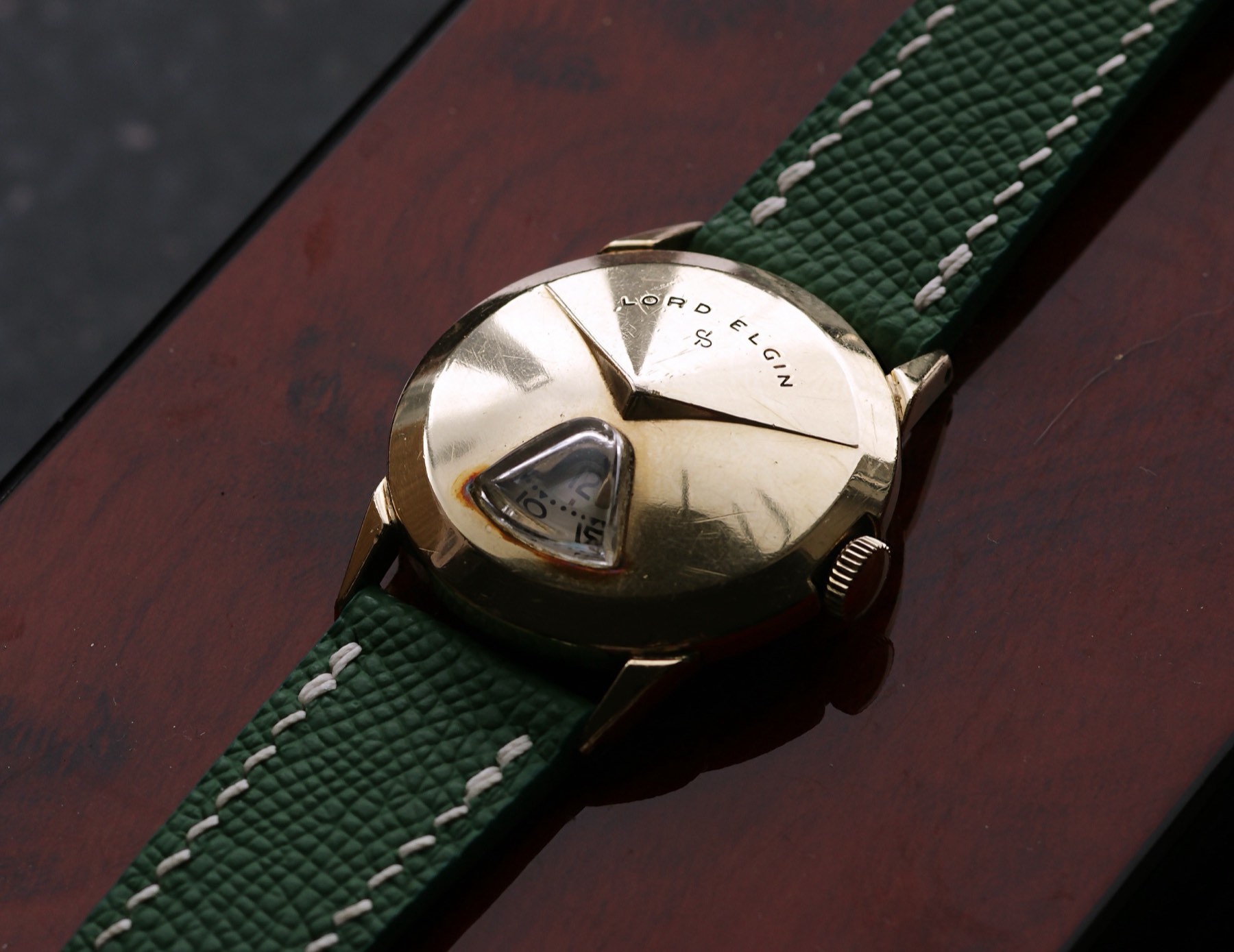
There exist timepieces whose character discloses itself gradually, and then there is the Lord Elgin Direct Reading Ref. 7775.
Known to collectors as the "Chevron," it presents itself almost entirely as case: a broad, reflective disc of gold with four sharp lugs, a monumental V-shaped ridge traversing its upper hemisphere, and one small triangular aperture positioned near six o'clock. The familiar architecture of dial, hands, markers, and sub-seconds has vanished entirely. Time has been compressed into two rotating numerals glimpsed through a window.
It is strange, glamorous, and unmistakably a product of the American mid-century imagination.
At roughly thirty-one millimeters across, the Chevron is not large by modern standards, yet its near-dialless case lends it a more substantial presence. The raised chevron catches the light like the hood ornament of a concept automobile, while the triangular aperture evokes an instrument on an aircraft dashboard. Originally, the upper portion appears to have received a satin or matte finish, contrasting with the polished lower surface—a distinction frequently softened or erased by decades of refinishing. The name "Chevron," incidentally, appears to be a later collector coinage rather than an official Elgin model designation. Period materials simply described it as a round Lord Elgin Direct Reading watch. Worn & Wound's examination of the Ref. 7775 documents both the contrasting finish and the case's remarkable sculptural construction.
Yet as memorable as the case may be, the more compelling narrative lies beneath it.
From "Peek-a-Boo" to Production
Elgin first presented the concept publicly at the National Jewelry Fair in Chicago during July of 1954. The initial "Peek-a-Boo" watch was reportedly a non-functional design model: a suggestion of how a wristwatch might display time without conventional hands.
This timing merits consideration. In the early nineteen-fifties, American industrial design was turning decisively toward jet aircraft, atomic science, television, and the promise of space travel. Automobiles sprouted fins and wraparound windshields. Household appliances were shaped like turbines. Against this cultural backdrop, a watch that revealed time through a cockpit-like aperture seemed not eccentric so much as inevitable.
Translating the display model into a dependable watch proved considerably more difficult.
According to the surviving Elgin Direct Reading history, product engineering manager Max Favret developed the mechanism with Elgin staff including Rudy Krauss, Bob Hall, and Norm Beth. Their solution employed Elgin's existing "basic 13/0 movement" and added approximately fifteen components for the direct-reading display.
A working prototype appeared at the 1955 Chicago and New York jewelry shows. Elgin prepared production inventory for January 1956, and an early known newspaper advertisement appeared on March 13 of that year. The Direct Reading family remained in Elgin's catalogue in various forms until approximately 1962.
The Chevron therefore belongs most convincingly to the 1956–57 period, although individual examples should ideally be dated by their movement and case markings.
The Grade 719
Within the Ref. 7775 resides Elgin's Grade 719, a hand-wound, twenty-one-jewel movement with shock protection. It operates at 18,000 vibrations per hour and offers a power reserve in the neighborhood of forty hours. Its conventional movement footprint measures approximately 19.3 by 23.8 millimeters—the American 13/0 size employed across a family of closely related Elgin calibers.
Elgin's movement-grade records identify the 719 as a domestic, twenty-one-jewel, Direct Reading movement with Shockmaster/KIF protection. The same technical family includes the seventeen-jewel Grade 717 and the twenty-three-jewel Grade 721.
The question of the 719's base movement requires careful consideration.
Elgin's public history refers to it only as the company's "current basic 13/0 movement." No factory document located in this research explicitly states that the Grade 719 was "based on Grade 713." Nevertheless, the Grade 713 emerges as the strongest candidate for its conventional foundation.
The 713 and 719 share identical dimensions, jewel count, beat rate, power-reserve range, domestic construction, Lord Elgin positioning, and shock-protection system. Parts listings offer further circumstantial evidence: stems and numerous screws were shared across the 711–721 family, while at least one endstone-clamp screw is specifically catalogued for both the 713 and 719. The Ranfft movement archive for the Grade 713 and its entry for the Grade 719 demonstrate the close correspondence between the two movements.
The most responsible conclusion, then, is that the 719 belongs to the Grade 713's basic architectural family, with a specialized direct-reading module constructed above it. It should not be described as a conclusively documented "713 conversion" until a period Elgin drawing or parts list explicitly confirms that relationship.
How the Jumping Display Functions
The display consists principally of two discs.
A transparent minute disc rotates continuously. Its numerals pass across the triangular window in the same steady manner that a conventional minute hand moves around a dial. Beneath it sits the hour disc, which carries the hour numerals.
The hour disc does not creep gradually between numbers. Instead, the mechanism stores energy in a small spring. An actuating cam and pawl control the release, and once every hour the trigger permits the preloaded spring to advance the hour carrier rapidly by one position.
This detail warrants emphasis. If the movement had simply driven the hour disc forward directly, the load required to make it jump could have produced a discernible drop in balance amplitude at the top of every hour. Favret's spring arrangement separates the energy required for the jump from the instant of release. The spring remains under controlled tension and snaps the hour display into its next position when triggered.
In practice, the watch offers two distinct kinds of motion within the same small window: minutes glide; hours jump.
Surviving photographs of disassembled examples reveal the compactness of the entire arrangement. The minute disc and hour disc sit above a miniature collection of carriers, cams, springs, gears, and levers, all fitted onto a movement that began as a fairly traditional American hand-wound caliber.
A period-style service presentation is reproduced in the CrazyWatches examination of the related Grade 717. Its illustrations identify the minute-disc carrier, cannon pinion, actuating cam, pawl, spring, and hour carrier. A separate Grade 719 Chevron examination demonstrates how the same principles were packaged in the round Ref. 7775.
These service illustrations presently constitute the closest publicly accessible material to a mechanical drawing of the 719's display module. A period Elgin technical-manual discussion has also survived through the NAWCC collector archive, although complete original factory documentation remains elusive.
A Complication Forged from Plastic, Patience, and Optimism
The most visually striking component is also one of the most vulnerable: the transparent minute disc.
Elgin required a material that was light, transparent, stable, printable, and sufficiently rigid to rotate without distortion. The company reportedly conducted temperature tests ranging from below freezing to more than two hundred degrees Fahrenheit while developing the display.
These experiments did not render the assembly immortal.
Collectors and watchmakers report cracked or warped minute discs, flaking numerals, peeling hour discs, weak or distorted jump springs, and mechanisms that jam when the discs are not perfectly aligned. The transparent disc can be damaged by careless handling during service alone. Elgin consequently designed special tools for removing and positioning the display components.
A photographic Grade 719 teardown by Elgintime conveys the difficulty more eloquently than any specifications table. Once the display has been removed, the underlying movement appears reassuringly conventional. Reassembling and synchronizing the discs is another matter entirely.
This is not a jump hour that should be entrusted casually to a repairer unfamiliar with the caliber. An intact disc set and functional jumping assembly can prove more significant than cosmetic case condition, because replacement display parts are substantially more difficult to obtain than ordinary movement components.
This fragility constitutes part of the Chevron's modern reputation. Collectors admire it as an unusually ambitious piece of American engineering, while watchmakers approach it with the cautious respect generally reserved for mechanisms that combine rare parts, delicate printed surfaces, and spring-loaded components.
The 10K Gold-Filled Case
The example under discussion bears a 10K gold-filled case. This designation should not be conflated with solid ten-karat gold, nor with an ordinary flash of electroplating.
Gold-filled material is produced by mechanically bonding a layer of gold alloy to a base-metal body. Under present American trade guidance, the gold-filled designation applies when the mechanically affixed gold-alloy layer accounts for at least one-twentieth of the article's metal weight. The karat number describes the fineness of that outer alloy—not the composition of the entire case. The distinction is explained in the U.S. FTC Jewelry Guides, 16 CFR §23.3.
Gold filling offered Elgin a practical middle ground. It supplied the warmth, polish, and perceived luxury of gold while remaining affordable enough for a comparatively experimental wristwatch. It was also considerably more robust than a thin decorative electroplate.
Even so, the Chevron's architecture creates a natural point of vulnerability. The tip and edges of the raised V receive repeated contact during use and polishing. On worn examples, the underlying base metal may first appear at the chevron's point. Heavy refinishing can also flatten the ridge and obliterate the original boundary between the satin and polished surfaces.
Published examples of the Ref. 7775 are often described as 14K gold-filled, including a Heritage Auctions example from circa 1957. A 10K gold-filled marking on this watch may represent a less frequently documented case execution. A sharp photograph of the complete interior case-back stamp would be valuable for confirming the maker, gold-filled specification, and any case-production number.
Following the Patent Trail
For a watch this unusual, one might expect to find a patent drawing showing the hour disc, trigger spring, or dramatic chevron case.
Thus far, no precise patent has surfaced.
A search through indexed Elgin, Wadsworth, and Star Watch Case Company records has not identified an issued ornamental-design patent specifically illustrating the Ref. 7775. Nor has it revealed a clearly assigned patent for the 717/719/721 Direct Reading module itself. This does not prove that no application or internal drawing ever existed; it indicates that no confidently matching issued patent was located in the publicly indexed material examined.
The closest relevant case document is Arthur W. Wadsworth's U.S. Patent 3,020,703, "Sealed Watch Case", filed in 1953 and assigned to Elgin. Its drawings describe a snap-back case utilizing a movement ring and resilient sealing band. The document offers useful evidence of Elgin's contemporary case-engineering work, particularly following its acquisition of Wadsworth, but it is not a patent for the Chevron's visible V-shaped design, and there is no present evidence that Ref. 7775 employed the patented system exactly as drawn.
The Direct Reading mechanism may simply have been protected through ordinary company engineering practice, manufacturing know-how, service literature, or an application that never became an easily identifiable issued patent. In this instance, surviving service diagrams prove more revealing than the patent record.
What About Elvis?
Elgin's Direct Reading watches are frequently linked with Elvis Presley, though this association demands some qualification.
The "Elvis" nickname is generally attached to a rectangular Direct Reading model. Elgin's historical account states that Presley wore such a watch on at least one occasion. No comparable period photograph, receipt, advertisement, or provenance has been located connecting Elvis—or another major celebrity—specifically to the round Ref. 7775 Chevron.
It is therefore reasonable to place the Chevron within the same Elgin Direct Reading family that produced the so-called Elvis model. It is not reasonable to advertise every Chevron as an "Elvis watch."
This distinction does not diminish the Ref. 7775. If anything, the watch is sufficiently distinctive that it requires no borrowed celebrity.
An American Vision of Digital Time
The Lord Elgin Chevron arrived before electronic watches, before LED displays, and decades before "digital" became synonymous with a screen. Its digital character is entirely mechanical: numbered discs, a wound mainspring, a conventional balance, and a tiny stored-energy mechanism that changes the hour instantaneously.
Its case looks toward the future, but the engineering beneath is unmistakably rooted in Elgin's traditional American movement manufacture. This tension is what renders the watch compelling. It is simultaneously a dress watch, an industrial-design object, a jumping-hour complication, and a record of an American manufacturer attempting to reinvent the manner in which time could be read.
The Chevron was not merely an unusual dial placed over a common movement. Elgin had to develop transparent display components, solve the energy problem of the hourly jump, create dedicated service tools, and instruct watchmakers in the assembly of a mechanism unlike its standard hand-wound watches.
It was a considerable investment of engineering resources for a triangular window.
Today, collectors value the Ref. 7775 not because it is the easiest vintage Elgin to own—it emphatically is not—but because so few watches capture their era so completely. The polished flying-saucer case, the architectural V, the miniature numerical display, and the sudden top-of-the-hour jump all belong to a particular moment when American industry believed the future should look dramatic.
Nearly seventy years later, the Lord Elgin Chevron still does.